Concrete vs. Brick vs. Stone: Choosing Exterior Materials for GTA Climates
Concrete vs. Brick vs. Stone: Choosing Exterior Materials for GTA Climates
A material can look exceptional on a sample board and still be wrong for your home.
In the Greater Toronto Area, exterior walls must handle rain, snow, humidity, winter freezing, road-salt exposure and seasonal temperature changes. Environment and Climate Change Canada’s Toronto climate normal document this annual variation in temperature and precipitation.
So, which option is best: concrete, brick or stone?
There is no universal winner. The right choice depends on the product, wall assembly, architectural style, exposure, maintenance expectations and installed cost. For many custom homes, the smartest answer is a coordinated combination.
What the GTA Climate Demands From an Exterior
Cladding is only one part of the weather-control system.
A durable exterior also needs a water-resistive barrier, drainage space, flashing, weep openings, sealants, insulation and carefully detailed transitions around windows, doors and roofs. Building-science guidance recommends a drainage plane behind exterior cladding so water that passes the surface can leave the wall.
That principle matters throughout the GTA and similarly cold areas of the northern United States. Trapped moisture can contribute to staining, mortar deterioration and freeze-thaw damage.
Concrete vs. Brick vs. Stone at a Glance
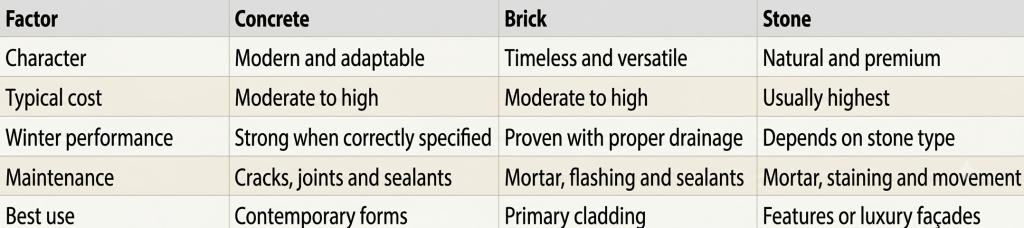
These are general tendencies. Product specifications, detailing and workmanship can change the result.
Concrete Exteriors: Modern but Detail-Sensitive
“Concrete exterior” may mean cast-in-place architectural concrete, precast panels, concrete masonry units or manufactured concrete veneer.
Concrete works well on contemporary homes because it can create large surfaces, deep reveals, crisp geometry and textured finishes. Its strength, however, does not make it maintenance-free. Cracking, staining, scaling and failed joints can result from weak specifications or poor execution.
For material exposed to freezing and moisture, the mix matters. The Portland Cement Association identifies intentionally entrained air as a widely used strategy for improving concrete’s freeze-thaw durability.
Choose concrete when you want a modern appearance and have a team experienced with the exact system being installed.
Brick Exteriors: Reliable and Flexible
Brick suits traditional GTA streetscapes, yet long-format units, monochromatic palettes and recessed joints also work on modern homes.
On most contemporary houses, brick veneer is a non-structural exterior layer attached to its backing with ties. A cavity, water-resistive barrier, flashing and weeps manage water that penetrates the masonry. Brick Industry Association guidance explains that a drained brick wall collects water on flashing and directs it outside through weep openings.
Brick often balances durability, design range and lifecycle value. Poor flashing, blocked weeps or unsuitable mortar, however, can undermine premium materials.
See these exterior design tips for luxury homes in the GTA when planning the complete façade.
Stone Exteriors: Premium and Product-Specific
Stone creates natural variation and a sense of permanence, but “stone” is not one product. Choices include full-bed natural stone, thin natural veneer and manufactured concrete stone, each with different support and installation requirements.
Stone is particularly effective around entrances, chimneys, columns and lower walls. It can cover an entire elevation when the architecture and budget justify it.
The Natural Stone Institute notes that not every stone variety is appropriate outdoors. It recommends choosing material with a successful weathering history in the local climate and obtaining supplier confirmation.
That means limestone, granite and sandstone are not interchangeable. Absorption, finish, bedding orientation and exposure matter. Homeowners interested in authentic textures can explore the return of natural materials in modern mansion design.
Which Material Costs More Over Time?
Stone is generally the premium option, especially when it requires substantial support, custom cutting or specialist labour. Brick often occupies the middle, while concrete prices vary widely because precast panels and manufactured veneer are different systems.
Compare total installed cost, including support, delivery, scaffolding, anchors, membranes, flashing, mortar, sealants, labour, waste and future repairs.
Higher pricing does not automatically create a better wall. Evaluate lifecycle value alongside the factors discussed in why luxury custom homes deliver high ROI in the GTA.
Why Mixed-Material Exteriors Often Work Best
A custom home might use brick as its primary cladding, natural stone around the entrance and architectural concrete at the garage. This controls cost while creating depth and visual hierarchy.
Restraint is essential. Limit the palette, align transitions and review samples outdoors. Too many colours and joint patterns can make an expensive façade feel fragmented.
Materials should also suit the home’s overall language. These modern luxury home architectural styles in Ontario offer useful context.
A Practical GTA Example
Consider a hypothetical contemporary Oakville home using warm grey brick across most elevations, limestone at the entrance and architectural concrete around the garage.
Brick manages the overall budget, stone creates a focal point and concrete reinforces the geometry. Where they meet, the builder must coordinate flashing, drainage, movement joints and support.
Roof edges and runoff should be planned at the same time, so compare roofing options for luxury custom homes in Canada before finalizing the façade.
Seven Questions to Ask Before Choosing
- Is the exact product suitable for exterior freeze-thaw exposure?
- Is it natural, manufactured, full-bed, anchored or adhered?
- What structural support does it require?
- How will water drain behind it?
- Where will flashing, weeps and movement joints go?
- What maintenance should you expect?
- Can the installer show comparable GTA projects?
Frequently Asked Questions
Is Brick or Stone Better for Canadian Winters?
Both can perform well when the product is suitable and the wall includes correct drainage, flashing, mortar and movement details.
Is Concrete Suitable for a Luxury Exterior?
Yes. Architectural concrete can create a refined contemporary finish, but joint design and installation quality are critical.
Is Stone More Durable Than Brick?
Not automatically. Performance varies with stone type, absorption, exposure, anchoring and workmanship.
Does Brick Improve Energy Efficiency?
Brick adds thermal mass, but insulation, airtightness and thermal-bridge control have greater influence on energy performance.
Can All Three Materials Be Combined?
Yes. A controlled mixed-material palette can balance cost, durability and visual impact.
Which Material Requires the Least Maintenance?
Brick is often relatively low maintenance, but every masonry exterior needs periodic inspection of mortar, sealants, flashing, weeps and cracks.
Choose the Exterior as a Complete System
Concrete offers modern flexibility. Brick delivers timeless versatility. Stone creates natural distinction.
The best choice is the material—or combination—that suits your architecture, exposure, wall assembly and long-term priorities.
Planning a custom home in Toronto or the GTA? Contact Woodcastle Homes to compare exterior materials, coordinate climate-appropriate wall details and create a façade built for lasting performance and architectural impact.